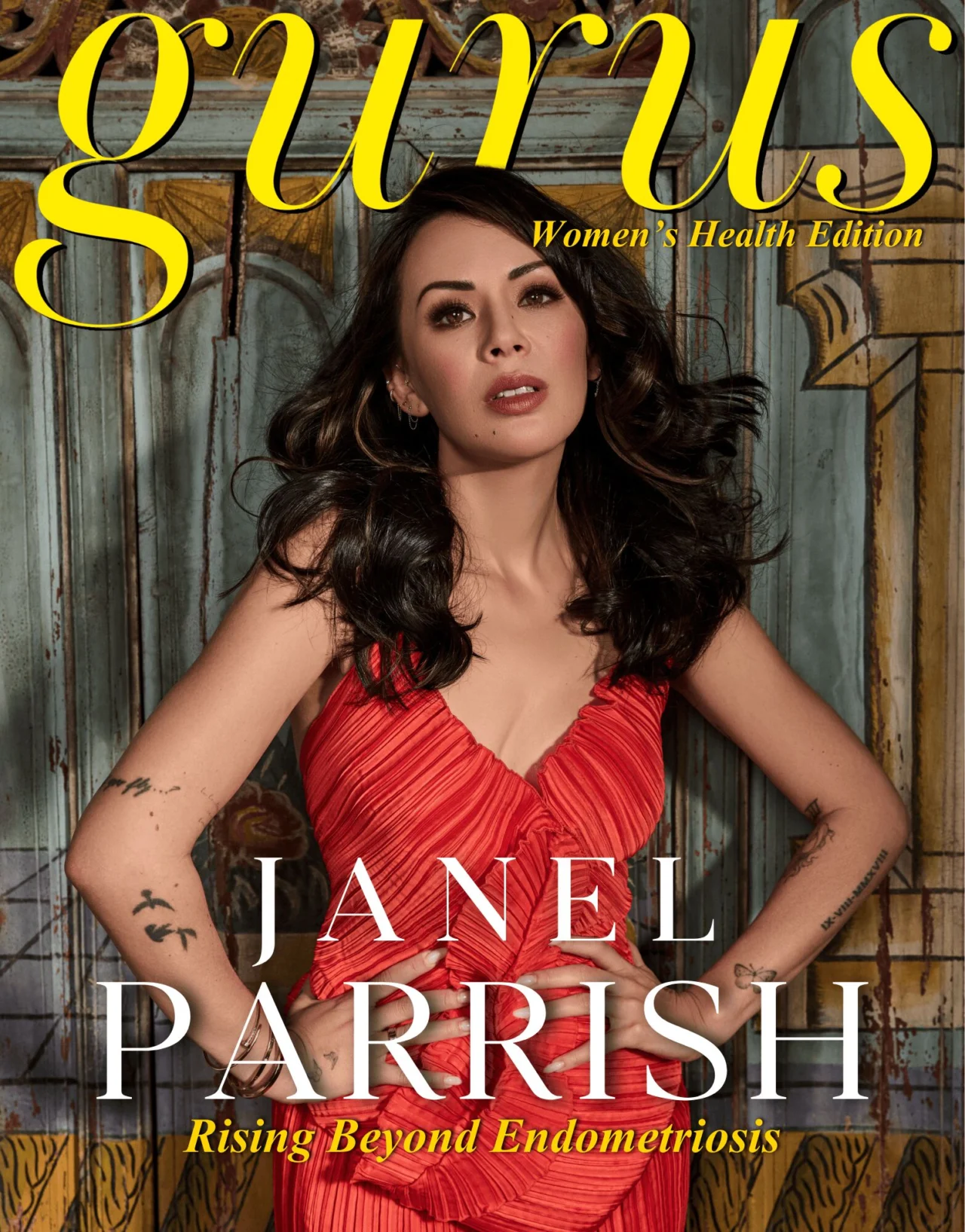
It was raining in Topanga Canyon the day Janel Parrish declared she was done being quiet.
Inside, the Gurus Magazine shoot softened the world into something cinematic. Parrish, who sat luminous, warm, and disarmingly open, was talking about something far less romantic than the mist that covered the hills that day: the disease that had silently taken root in her body and nearly upended her future.
For many women, endometriosis takes years — even decades — to diagnose. Parrish’s story moved quickly, but it was no less harrowing.
“I know that sometimes it takes a lot of women a long time to get diagnosed,” she says. “Mine was silently growing for many years before I even felt a symptom. Once I realized what it was, it was fast and furious for me.”
At first, the signs were subtle. After getting off birth control, her periods became heavier. More painful. She gained ten pounds she couldn’t lose. Her abdomen swelled persistently.
“I constantly looked like I was pregnant,” she says. “Which I now know is ‘endo belly.’ And I couldn’t understand why. I just thought I must be getting older. Hormones.”
There wasn’t much pain — until there was.
“It was ironically the night that my husband and I decided to start trying for kids,” she recalls. “I knew I was ovulating. I was like, ‘Let’s go.’”That night, she was hit with what she describes as “a stabbing electrical pain” in her right ovary. “It went on for about a week. I kept saying, maybe it’s digestive. Maybe it’s ovulation pain. But it got to the point where I couldn’t sleep. I was writhing in pain. Sobbing.”
Her husband took her to urgent care. A CT scan. A possible fibroid. Then, ovarian cysts. Then something far more terrifying. “My MRI lit up, and they didn’t know what it was,” she says. “Then they thought it was ovarian cancer.”
For three months, she lived inside that uncertainty — debilitating pain, mounting fear, and a calendar full of professional commitments she refused to abandon.
“I couldn’t go or do anything without the fear of thinking, ‘Is it going to hit right now?’ And when it did, I would be doubled over. I would want to throw up. Nothing would help.”
Eventually, she was referred to a gynecologic oncologist.
“He said to me, ‘Worst case scenario, it’s ovarian cancer. Best case scenario, you might have a really bad case of endometriosis.’ And I said, ‘I don’t even know what that is.’”
There is no definitive test for endometriosis outside of surgery.
“He said, ‘I won’t know until I cut you open,’” Parrish recalls. She went into her first surgery not knowing if she would wake up to a hysterectomy. “My doctor had said to me, ‘If I go in there and I see cancer, I’m going to take everything.’ And of course, my husband and I said yes. Take everything.”
She pauses.
“I didn’t know what I was going to wake up to.” When she opened her eyes, it wasn’t cancer.
“Good news is not cancer,” she recalls the doctor saying. “Bad news — you have stage four endometriosis.”
Her first surgery removed cysts and included ablation — a procedure that burns away visible lesions but does not remove them at the root. She was prescribed Orilissa, a hormone-suppressing drug intended to manage symptoms.
“The side effects were horrible,” she says. “Mood swings. Hot flashes every 20 minutes. I just didn’t feel like myself. But I was told it was treating my endo.”
Six months later, imaging showed the disease returning.
“My doctor said your endo is growing back, but it ‘didn’t excite him enough’ to do another surgery,” she says, incredulous. “His recommendation was to get pregnant and do IVF.”
She laughs — but it’s sharp.
“I was just angry. I thought, ‘This doesn’t make any sense.’ IVF gives you doses of estrogen. Estrogen fuels endo.” The idea that pregnancy could be positioned as a “treatment” unsettled her. “To tell women that a treatment is pregnancy? It’s infuriating.”
Instead of accepting that advice, Parrish did something many women are forced to do: she became her own researcher.
“I went down a Reddit rabbit hole. What is endometriosis? What are women doing?”
That’s when she learned about excision surgery — the gold standard for treating endometriosis — and that not all surgeons are trained to perform it.
“I never would have known,” she says. “No specialist or doctor had ever told me that there were even endometriosis specialists until I did the research myself.”
She consulted four surgeons. All agreed: she had a severe disease and needed excision surgery. One name kept surfacing among her friends. “Iris Wings” — Dr. Iris Kerin Orbuch — was recommended to me by like five of my girlfriends.” Under the care of Dr. Iris Kerin Orbuch and her team, Parrish felt something she hadn’t felt before in a medical setting. “I walked in there, and I just felt so seen. I felt so heard.” Another specialist, Dr. Rayan Elkattah, walked her through everything.
“He said, ‘Do you know what this is?’ I’m like, no. He’s like, ‘That’s your ovary. And that’s what endometriosis looks like.’ I had never had a doctor explain to me in such depth what was going on in my body.”
She exhales. “It made me feel less crazy.”
Her second surgery, in December 2025, lasted six hours.
“They were shocked at the amount of disease I had,” she says. “Endometriosis was basically everywhere. All of my organs were stuck together.” When she woke up, the doctors told her they had removed everything visible. “I just burst into tears. I felt so grateful.” The difference was immediate. “It was night and day,” she says. “They’re excising it. They’re pulling it out at the root.”
She shakes her head at the irony.
“For the amount of disease that I had, I didn’t actually have pain the second time around. That’s what’s crazy about endo. It’s so sneaky.”
But during filming for XO, Kitty, she was quietly unraveling.
“My pain was a 12,” she says. “And I was flying to Korea to do an episode. Nothing was going to keep me from doing that.”
The long flight was agony. “Yes, it’s the pain,” she says. “But it’s the anxiety. ‘Oh my God, am I going to be okay? Am I going to be able to walk? I’m so bloated I look like I swallowed a watermelon.’”
On set, during a 15-hour day, she relied on extra-strength Tylenol and a heating pad that eventually died. “I still had like seven hours on set. I was like, “’ Do I hide this?’”
Her face turned pale, she recalls. A makeup artist approached her. “She said, ‘Are you okay? You look like you’re in so much pain.”
Parrish hesitated — then told her the truth.
“I think I have endometriosis.” The woman’s response was immediate. “She goes, ‘Me too.’” That stranger helped her get heating pads, medication, whatever she needed.
“I wouldn’t have been able to get through that day if she hadn’t been like, ‘I got you.’ That’s sisterhood.”
For weeks, Parrish debated whether to share her diagnosis publicly. “It’s a very vulnerable thing to share,” she says. But she remembered how alone she felt, scrolling the internet at 3 a.m. “I combed the internet for hours to find stories about women going through the same thing. It made me feel less alone.”
“The response was overwhelming,” she says. “Thousands of women are writing to me. ‘Thank you for posting about this.’”
Now, she sees advocacy as part of her calling. “Any kind of spotlight we can shine on this disease — I am so happy to lend my voice.”
Her message to Congress? To dismissive doctors? “Enough is enough,” she says. “So many women are suffering for years, decades. Help us. Hear us.”
She is blunt about misinformation. “I was told pregnancy could cure it. I was told a hysterectomy would cure it. Those things are not true. We need to be told the truth.”
And to women navigating their own diagnoses? “You are so not alone,” she says, her voice catching. “I know it’s such an isolating thing. You feel broken. Like, what’s wrong with me?”
She shakes her head.
“We see you. We hear you.”
Living with endometriosis is not just physical. It is emotional. Psychological. Existential. “The anxiety, the fear — that’s the hardest part,” she says. “The fear of like, okay, this is out of me now. When’s it coming back?”
A therapist once gave her advice she now repeats often.
“Endometriosis is going to be with you, possibly forever,” Parrish says. “How do you live with it? Invite it to tea.”
She laughs softly.
“I could sit here and go, why, why, why? And I did for months. Be mad. You’re allowed to be mad. But at the end of the day, I’m trying to invite it to tea. Because it’s not going to rule my life.”
So to everyone reading this, “We f-ing got this,” Parrish says. “Women are so strong. Doesn’t matter if we’re told we’re not. We are.”
Parrish directs her words toward women everywhere. “I see you. And I love you. And I hope things can be better for us in the near future.”